For the last two weeks, everyone at BibleProject has been on vacation, a practice we refer to as synchronized rest. It’s a policy we’ve implemented where we choose to put down our work three times per year (2 weeks in July, the week of Thanksgiving, and the week between Christmas and New Years), and it’s one of the most important annual practices we’ve instituted.
Why synchronized rest?
There are lots of reasons why we rest together. Some are practical; some are philosophical; all are rooted in our desire to pursue and reflect wisdom. I’m going to talk about a few of them here, and I hope you find them helpful. Just something to consider.
Synchronized rest is a reflection of our values
At BibleProject, our Organizational Values are rooted in a desire to reflect the teachings and character of Jesus who, himself, was shaped by a lifetime of meditation on the wisdom of the Hebrew Bible (i.e. the Old Testament) and the unified story that he claimed reached its fulfillment in him.
We sometimes use the acronym G.U.T.C.H.U as shorthand for our Values (say it out loud and it sounds like you’re sneezing… so we hope it spreads ;)). They are:
- Generosity: Our God is a generous host, so we have an abundance mindset.
- Unifying: God is creating a worldwide and diverse human family, so we serve as a catalyst for its unity.
- Thoughtful: God invites us to live by his wisdom, so we are both empathetic and strategic.
- Creative: God created order out of chaos for life to flourish, so we innovate.
- Humble: God humbles himself by collaborating with humanity, so we treat every person as valuable and with something to offer.
- Unhurried: God rested in his work, so we toil sustainably and find rest.
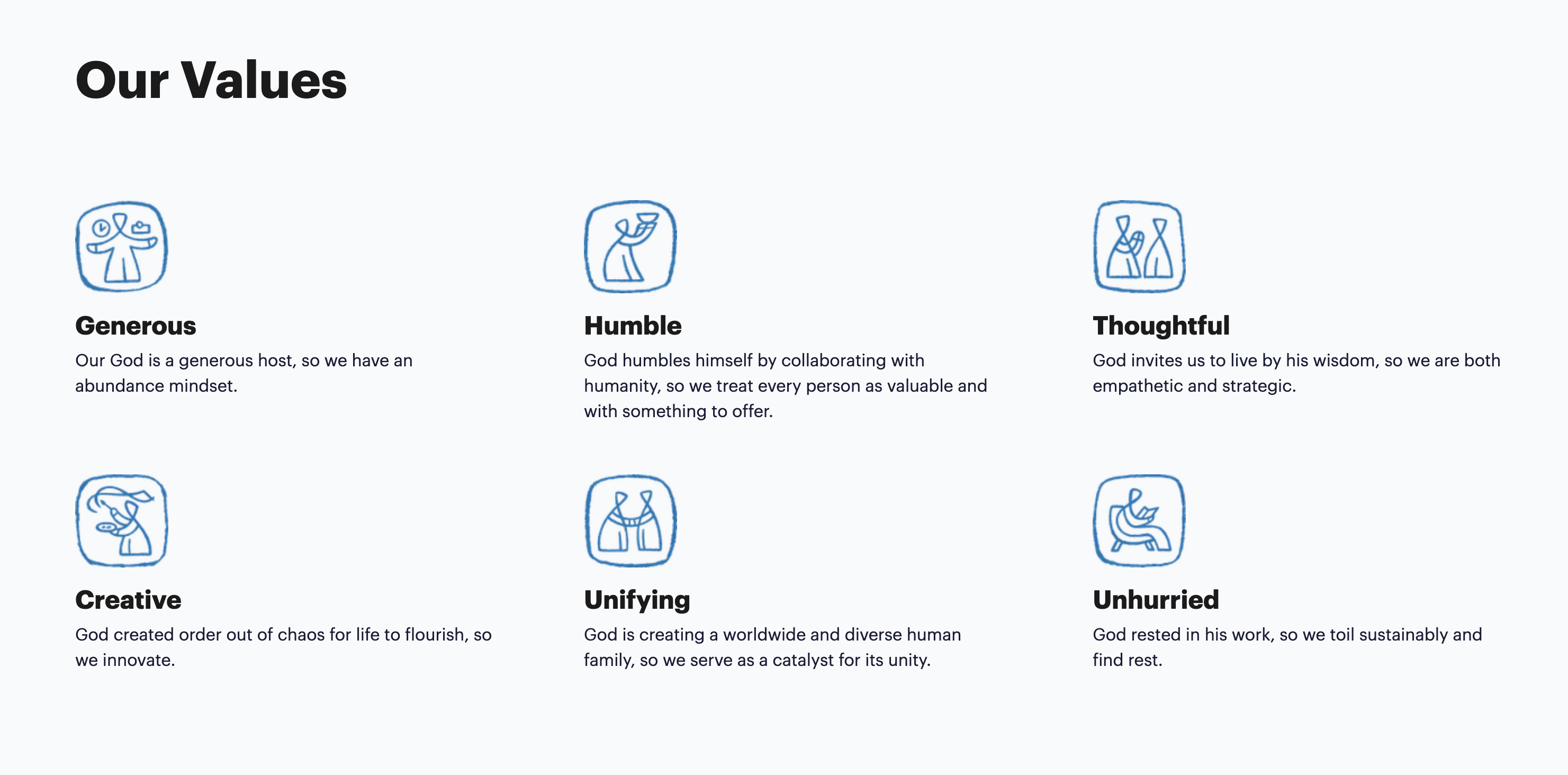
On the surface, the countercultural and somewhat misunderstood value of Unhurried maps directly on to a schedule of intentional rest; but the other values are also present in the practice.
- We practice synchronized rest together as an act of trust in God’s generosity and as a small demonstration of unity.
- Executing a practice like this requires a lot of thoughtful preparation, as we want to serve our audience faithfully even as we rest, so it takes creative problem-solving, innovative thinking, and focus to pull off a short-term cession of our work.
- Synchronized rest is also an act of humility, living out the belief that God (not anyone of us or even all of us) is the one who sustains our work.
Ultimately, synchronized rest is a reflection of the wisdom behind the concept in the Bible of Sabbath.
Synchronized rest is a rooted in the Sabbath
In the Hebrew Bible, the Sabbath is a weekly day of rest that God commanded the Israelites to observe. It’s the 4th of the 10 Commandments, and it’s the only one that’s not explicitly moral in nature. It’s a command to rest, to cease from work, and to trust that God will provide for you even when you’re not working. Sabbath is a part of a larger rhythm of annual and multi-year rest periods that God commanded the Israelites to observe, including the Sabbatical Year and the Year of Jubilee.
With each and all of these rest periods, God was teaching the Israelites to trust in his provision, to remember that they were not slaves to their work, and to reflect the character of God who rested after creating the world.
Trust in God’s provision and generosity is what motivated Jesus to teach his followers to “consider the lilies of the field” and to “not worry about tomorrow.” As a 21st century expression of the Kingdom of God mission that Jesus inaugurated, we practice synchronized rest as a way of embodying that trust in God’s provision and generosity. Can God be trusted or not? Jesus certainly thought so, and as an organization that seeks to reflect his teachings and character, we want to embody that trust in our work and in our rest.
The practical benefits of synchronized rest
At the heart of wisdom in the Bible is always a practical benefit for humankind. God’s instructions weren’t arbitrary; they were meant to help us flourish. The cycles of Sabbath are no different. Here are a few of the practical benefits we’re seeing from synchronized rest.
Synchronized rest serves our teams
Everyone who’s worked in a colalborative environment knows that it’s challenging to unplug when others are working. There’s an unspoken “tax” to traditional vacation time as communication, decisions, and tasks pile up while you’re away. The time before a week of vacation tends to be more work than a normal week, as does the time afterwards getting “caught up.” Synchronized rest lowers and even eliminates that tax, encouraging everyone to reflect and reset for our next season of work ahead.
Put simply: Rest together is more restful.
It’s also more generous for those who might otherwise be working. During a traditional vacation (particularly in an organization of less than 200), there is a real and tangible cost that my colleagues pay as they pick up the slack from the gap I’ve left. Conversely, there’s a sense of momentum and energy that comes from knowing that everyone is available and operating in a more unified rhythm that can’t (and shouldn’t) be easily replaced. We’re finding that lowering the number of times we’re out of sync with each other helps us deliver better work.
Synchronized rest serves our families
When we rest together, we’re able to be more present with our families in a way that’s hard to achieve on traditional vacation weeks. Synchronized rest gifts our team memebers and their families time without the distraction or worry of the work waiting for us; one that we hope promotes richer relationships with the people who matter most in our day-to-day lives.
Synchronized rest serves our mission
One of the things we emphasize internally at BibleProject is that we are a project. It’s never been or intention to do more than the work before us, in service to our audience and whatever has been provided to do our work. We see ourselves as another contribution in a long line of technolgoy contributions (scrolls, the codex, mass printing, and now the Internet) that is helping to make the Bible more accessible to more people.
We’re not a church or institution; we’re a project; and like all projects, ours will someday reach it’s conclusion.
That posture of humility holds in check the natural inclination to “build a bigger tower,” and synchronized rest reinforces that belief. It’s a reminder that we are not the ones who sustain our work, but that God is the one who sustains our work. It’s a reminder that we are not the ones who will bring the project to completion, but that God is the one who will bring the project to completion. The mission of helping people experience the Bible as a unified story that leads to Jesus is bigger than any one of us or all of us.
I’ve found that posture freeing, motivating, and inspiring, particularly as someone whose grown up in an expression of “church” that too easily confuses what God is doing in the world (God’s purposes to reunite heaven and earth and partner with humanity) vs. my small, momentary contribution.
And form personal experience, few things remind me of that more than ceasing from our work.
Synchronized rest serves our business
Over the Summer and the holidays seasons in which we’ve instituted synchronized rest, we’ve seen a marked increase in productivity and creativity in the weeks following. This hopefully makes intuitive sense, as we limit the inevitable inefficiency that comes from portions of the organization on vacation unevenly. Instead, we’re just all off during those times that are naturally more likely to require time away. It can seem a counterintuitive practice, but it’s one that’s paid dividends in the form of a more unified team, a more creative team, and a more productive team.
Synchronized rest serves our audience
I saw this first hand this last November as the Product Engineering organization was wrestling with substantial work we delivered in January 2024 to support the Sermon on the Mount. In the weeks leading up to Thanksgiving, the stress level of our teams was rising as we were running late on some more aggressive deliverables for the end of the year. Each day, we seem to be encountering new challenges, and I was bracing and plannning (but more the latter the former) for how we’d need to scale back our expectations even further for the end of the year.
Thankfully (though I didn’t know it yet), we had a week of synchronized rest coming up.
On the Monday following our week away, I was shocked how the team’s renewed sense of energy and focus virutally eliminated seemingly intractable obstacles. The challenges that seemed insurmountable the week before were now being tackled with a sense of calm and creativity that I hadn’t seen in months. The team was more unified, more creative, and more productive; and by the conclusion of that week, we were now well on track to meet our commitments.
I credit our time away and (as a person of faith) the blessing of God’s wisdom in the practice. We had committed ourselves to live out the wisdom called out in the Bible, and - surprise, surprise, it worked.
A 2000+ year old conclusion
Reflecting on that experience brought to mind the words of the Isaiah scroll, offered more than 2000 years ago to a people being called to live out God’s wisdom for seasons of work and rest:
“Keep the Sabbath day holy. Don’t pursue your own interests on that day,
but enjoy the Sabbath and speak of it with delight as the Yahweh’s holy day.
Honor the Sabbath in everything you do on that day,
and don’t follow your own desires or talk idly.
Then the Yahweh will be your delight. I will give you great honor and satisfy you with the inheritance I promised to your ancestor Jacob.
I, Yahweh, have spoken!”
Isaiah 58:13-14